CouponFYI Frequently Asked Questions
Look, coupon codes sound simple. Copy one, paste it at checkout, and save a few bucks. But if you’ve actually used coupons for more than five minutes, you know it’s messier than that. Codes expire. Some only work for new customers. Others are locked to one country, one product, or a minimum order size. And sometimes a code works fine for the next person and does absolutely nothing for you.
So here’s the real breakdown of how CouponFYI works. Where our codes come from. How we check what we can. What our status labels actually mean. How listings get updated. And how the site makes money. No corporate fluff, just the real answer.
How We Find and Test Coupon Codes
How does CouponFYI find and test coupon codes?
We don’t pull coupon codes from one place, and I’m not going to pretend we do.
Some of the offers we share here come straight from stores and service providers, through their websites, promotions, or marketing emails. Some come through affiliate and partner networks, where retailers and their partners share coupon information with sites like ours. A lot come from the same places you’d find them yourself: the open web, social media, search results, and other public sources.
Shoppers help too. When someone uses a code from CouponFYI, they can tell us whether it worked. That matters, because a code that was solid last week can be dead today, and a shopper’s report can be a useful way for us to find that out.
The source can be different from one listing to the next. So we don’t treat every coupon like it came straight from the retailer, because not every listing does.
One more thing worth being clear about: where a code comes from and whether it’s been verified are two separate things. A code can come from a retailer, a partner network, the open web, or a shopper report, none of that by itself makes it Verified by Editor. Verification is about what I was actually able to confirm at checkout, not where the code originally showed up.
Finding a code is easy. Knowing whether it actually still works is the hard part.
I’m not going to claim every single code gets a personal checkout test from me, because that’s not true. When I can test a code myself, I do. That means going through an actual checkout, adding something to a cart, entering the code, and seeing whether the discount actually shows up.
Beyond that, we work with what’s available: shopper reports, source information, freshness, the discount itself, and whatever terms are attached to the offer.
Here’s why that combination matters. A checkout test tells you the code worked at that exact moment, under those exact conditions. It doesn’t tell you it’ll work an hour from now, for a different product, or for someone in a different country. That’s where shopper reports can help.
That’s also where the labels you see next to our codes come in.
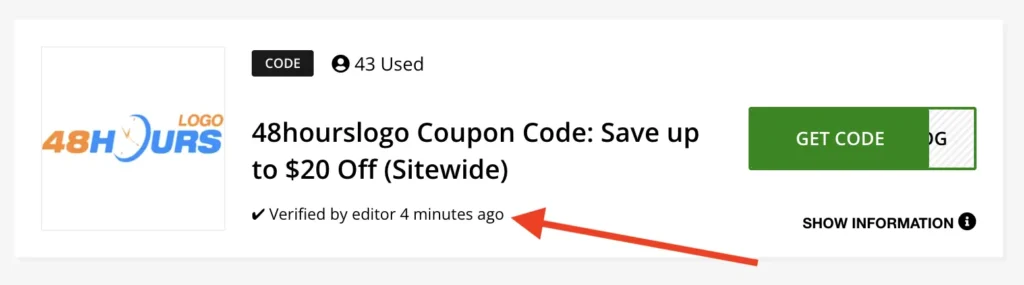
Verified by Editor means a CouponFYI editor personally tested the code at checkout, and it worked at the time of that test. The timestamp shows you when that happened.
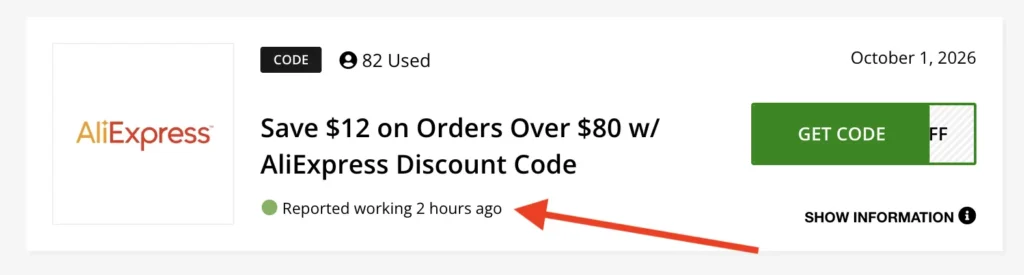
Reported Working means a shopper told us the code worked for them recently.
Last Used shows the most recent recorded activity associated with the code on our site, such as when someone copied or tried it. Think of it as an activity or freshness signal. It does not prove that the discount was successfully applied, and it doesn’t guarantee the code will work for you.
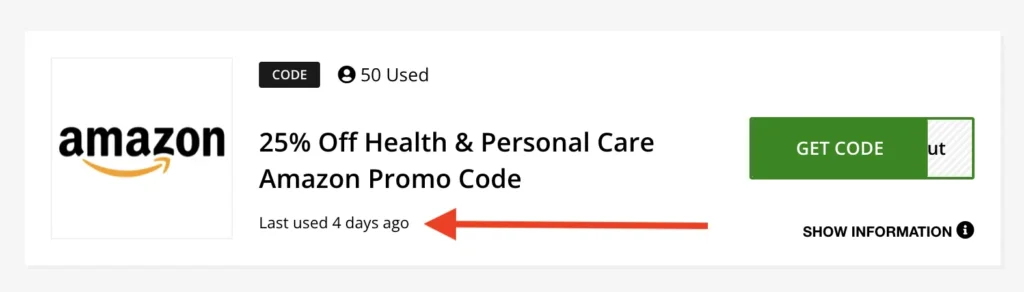
One important distinction: these status badges apply to coupons only. They don’t apply to regular deals or to listings in our “Expired Coupons & Deals” section. Expired coupons and past deals are kept separate from the active coupon listings, so a badge shouldn’t be taken as a verification or freshness signal for those listings.
That’s the whole idea. Test a code when we can, use shopper feedback as another piece of information, keep an eye on how fresh the information is, and be honest about what we actually know. No pretending every code is guaranteed.
What do you actually check when you test a coupon?
Testing a code isn’t just about whether the retailer accepts it at checkout. I’m looking at whether the discount actually shows up on the total, and whenever the retailer’s checkout makes it visible, what conditions come attached, things like a minimum order, first-time-customer restrictions, specific products, or account requirements.
A code getting accepted isn’t the whole story. What matters is whether the discount it promised actually applied, under the conditions I was testing it with.
How we evaluate and order promo codes?
We go off what we actually know: how fresh the code is, whether it’s been tested, what shoppers are reporting, and what restrictions we’re aware of.
A bigger number doesn’t automatically win.
A 10% code that’s fresh, relevant, and getting recent positive activity can be more useful than a 50% code that’s months old, loaded with restrictions, and hasn’t had supporting activity in a while.
So when we sort what you see, we’re going off the information and evidence available to us, not just slapping the biggest percentage at the top and calling it a day.
What if there's not enough evidence to call a code Verified by Editor?
Then I just say that.
Not every code gets tested, and not every code has shopper reports yet. When that’s the case, I’m not going to slap “Verified” on something I haven’t actually checked. You’ll see it listed with whatever information is available, source, freshness, maybe nothing at all yet, and that’s the honest state of it. “I don’t have enough evidence” is a real answer here, not a gap I’m trying to hide.
Why can a coupon still fail after being tested?
Here’s the part nobody likes hearing: even a code I’ve personally tested can fail for you.
That doesn’t mean I got it wrong or the code was fake. It can simply mean the promotion works differently depending on who’s using it.
Maybe it’s limited to first-time customers. Maybe it only applies to certain products. Maybe there’s a minimum order, a country restriction, an account-specific rule, or the retailer simply ended the promotion after I tested it.
Retailers can change things without warning.
I can’t control a store’s checkout system. No coupon site can. What I can do is tell you exactly what I know, when I knew it, and skip the part where I pretend every code is bulletproof.
For more help, read Why is My Promo Code Not Working? and Can You Use Expired Coupons?.
What happens when a coupon stops working?
A code testing successfully once doesn’t mean it stays that way forever.
If shoppers report a code has stopped working, or I find out the store changed the promotion, I go back and update the listing to reflect that. A code that passed my test last month isn’t proof it’s still good today, that’s exactly why the timestamp matters. It tells you when the test happened, not that the result still holds now.
I’d rather update the page than leave an old test sitting there looking like current proof.

How CouponFYI Makes Money
How does CouponFYI make money?
CouponFYI is free to use. Here’s the honest version of how that’s possible.
Some stores and services listed here have an affiliate or partner relationship with us. If you click through an eligible link and complete a qualifying purchase or action, the retailer or service provider may pay CouponFYI a commission.
It doesn’t normally cost you anything extra.
Not every store, coupon, or link on this site generates a commission. We can still list an offer where there isn’t a financial relationship behind it because it might genuinely help you save.
For the full details, see our Disclaimers & Disclosures page.
Does an affiliate commission affect which coupons appear first?
When we organize coupons, we look at information such as freshness, testing, shopper reports, discount details, and restrictions.
A commission isn’t proof that a coupon is better.
So a coupon that pays us nothing can still sit above one that does when the available information makes it the more useful offer for a shopper.
Why do you list stores you don't earn anything from?
Because a good coupon doesn’t stop being useful just because there’s no commission attached to it.
If an offer can genuinely help shoppers save, it can still belong on CouponFYI whether or not we earn anything from it.
General Coupon Questions
What's a coupon code?
A coupon code, promo code, or discount code is a string of letters, numbers, or both that you enter at checkout for a discount.
It might knock off a percentage, take a flat amount off, get you free shipping, or unlock another promotion.
The rules can vary a lot. Some codes have a minimum spend. Some only work on certain products. Some are for first-time customers or selected accounts. Always worth checking the details before you assume it’ll apply.
Where can I find a coupon code?
Coupon sites like CouponFYI are one option, but they’re far from the only one.
Stores publish their own promotions on their websites, in marketing emails, and on social media. You’ll also find codes through affiliate partners, browser extensions, online forums, communities, and other public sources.
Here’s the important part: finding a code somewhere doesn’t mean it’ll work for you. That’s true whether you found it here or on some random comment thread.
How do I use a coupon code?
Add what you want to your cart, head to checkout, and look for a field labeled something like “Promo Code,” “Coupon Code,” “Discount Code,” or “Have a discount code?”
Paste the code in and apply it.
Before you pay, actually check that your total dropped. If it didn’t change, the code didn’t apply.
Every store’s checkout looks a little different, so the exact wording and placement can vary.
Why does a coupon work for someone else but not me?
One of the most common coupon headaches out there.
Two people can enter the exact same code and get two different results because the retailer can apply different rules to different orders.
Maybe the code is tied to a specific account, first-time customers, certain products, a minimum spend, or a specific country.
A code working for someone else doesn’t mean you typed it wrong or that it’s fake.
Can coupon codes have minimum spending requirements?
Yes, plenty do.
A code might only kick in once your cart hits a certain amount. If you’re under that threshold, the code may not apply even though the code itself is real.
Check the coupon details before assuming there’s something wrong with the code.
Can coupon codes be restricted to certain products or customers?
Yes.
Some only apply to specific products or categories. Others are aimed at first-time customers, a particular account, or a specific country.
That’s usually why a code can be genuine and still not apply to your order.
Why do coupon codes expire?
Because they’re promotions, not permanent pricing.
Retailers can set end dates, cap the number of redemptions, run a short campaign, or end a promotion earlier than expected.
Once the retailer ends the promotion, the code can stop working whether or not it’s still sitting on a coupon site.
For more, read Can You Use Expired Coupons?.
Can I get a refund if a coupon doesn't work?
Not automatically, no.
A code failing at checkout doesn’t mean you’re owed a refund. That comes down to the retailer or service provider’s own policy and the circumstances of your purchase.
Your best move is catching it before you buy, not after. Confirm the discount actually applied before you finish checking out.
If you’ve already placed the order and something’s off, go straight to the retailer and check its refund policy.
Questions About CouponFYI
What is CouponFYI?
I’m Zouhair, and I started CouponFYI in 2023.
Honestly, the idea came from getting fed up. I kept running into broken links, expired codes, and messy coupon posts on social media, and I figured there had to be a better way to do this.
So I built something simpler: a place to find coupons, deals, shopping guides, reviews, and savings tips without digging through scattered sources to figure out what’s actually current.
Today, CouponFYI pulls offers from different sources and pairs them with shopping guides, reviews, and savings tips.
The goal hasn’t changed since day one: help people save money and be straight with them about what we actually know versus what we can’t promise.
I also bring first-hand experience to parts of the site. I worked as a designer on Fiverr myself, so when I write about that platform, it’s not just secondhand research.
You can read more in Is Fiverr Legit & Safe? Honest 2026 Review, learn more about how CouponFYI got started on our About Us page, or read about my background on my Author Profile.
How often does CouponFYI update its coupon database?
There’s no single moment where everything refreshes at once, and I’m not going to pretend there is.
Coupon information shifts throughout the day, so we’re watching our sources and updating listings as new codes, changes, or expiration information become available.
That means one store can have fresher information than another at any given moment.
It’s also why you’ll see testing dates and recent activity next to codes when that information is available. I’d rather show you the available evidence and let you judge the freshness for yourself than simply claim everything is current.
How do I report a coupon that doesn't work?
Head to our Contact Us page and let us know.
Include the store name, the code, and whatever you remember about what happened at checkout.
The more detail you can provide, the easier it is for us to investigate the listing and update it when necessary.
How do I get in touch with CouponFYI?
Same spot: our Contact Us page.
Questions, feedback, a dead code, whatever it is, that’s the place to reach us.
Can I share coupon codes from CouponFYI with others?
Go for it.
Use the share buttons on our coupon pages, or just grab the link and send it however you normally would.
One thing to keep in mind: a code that works today might not work for someone else tomorrow. Stores change promotions, and eligibility rules aren’t always the same for everyone.
Does CouponFYI have a mobile app?
A CouponFYI mobile app is coming soon.
For now, the website itself is built to work well on your phone, so you can browse stores, codes, deals, reviews, and guides without needing to install anything.
We’ll update this page when the app is available.
Does CouponFYI have a browser extension?
A CouponFYI browser extension is coming soon.
For now, you can use the CouponFYI website to find and copy coupon codes manually.
We’ll update this page when the extension is available.
Shopping Safety and Store Reviews
Where can I learn more about safe online shopping?
Coupons are only one piece of shopping online.
Before buying from a store you’ve never used, it’s worth looking at more than just the discount. Things like the retailer’s reputation, payment options, refund policy, and other trust signals matter too.
My guide Is Online Shopping Safe in 2026? covers the things I personally look at when deciding whether an online store is worth trusting.
For deeper looks at individual retailers and platforms, browse our Reviews section.
Where can I find store reviews on CouponFYI?
Our Reviews section is the place to go.
That’s where you’ll find deeper looks at individual stores, marketplaces, and online services. These reviews can help when a coupon isn’t the only thing you need to think about before spending your money.
Where can I find more ways to save money?
Coupon codes are only one part of saving money.
You can find more practical ways to spend less in our Tips section, where we cover shopping strategies, savings ideas, and guides that go beyond promo codes.
One place to start is Save Money Like a Pro: 16 Tips for Smart Shopping.
If Amazon is where most of your spending happens, the Ultimate Amazon Savings Guide 2026 brings several savings ideas together in one place.
About the Author and Our Transparency
Who is behind CouponFYI?
CouponFYI was founded by me, Zouhair, in 2023.
I’m a designer from Morocco, and honestly, my own experience with online shopping and freelancing on Fiverr is a big part of why this site exists the way it does.
You can read more about my background on my Author Profile, or learn more about the story behind CouponFYI on our About Us page.
Do you use AI to create content?
Yes, sometimes I use AI tools to help me sort information, improve my drafts, and help with research and writing. I review and check the facts before I publish anything. I do my own testing. I take my own screenshots. I share my own experiences and opinions. If I use something else, I say so clearly.
How can I learn more about your affiliate and business relationships?
We try to be upfront that CouponFYI can earn a commission from some links on the site.
That normally doesn’t add an extra cost to you, and not every store or link involves a commission.
For the full picture, including our commercial disclosures and other website policies, see our Disclaimers & Disclosures page.
By clicking the Subscribe button, I agree to the Terms of Use and have read the Privacy Policy .

Copyright © 2026 CouponFYI. All Rights Reserved